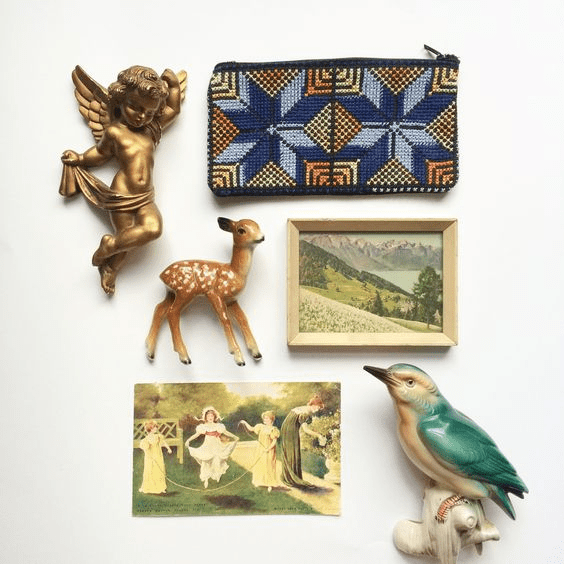
In what ways are a miniature’s value not proportionate to its size?
The ability to focus large and complex ideas into a small frame, whilst communicating its ideas in a concise manner is no easy feat, and yet the miniature, in all its archetypes, achieves it effortlessly. Its
size forces us to inquire deeper into its meaning, and weigh up all possibilities for its existence; in some cases applying our own meaning. In other words, the miniature satisfies our desire to nurture
and transform seemingly unimportant objects into ones of great personal significance.
for full access email redrudy@myyahoo.com
‘even outside the context of miniatures, consumers seek to attain objects which give them the emotional experience that objects once supplied them, being sold a commodity as a prop to allocate those emotions (Bartholome, 2020). What is emphasised here, is that a sentimental connection with our objects is undeniably human, perhaps a necessity in our everyday lives.they express our identities more effectivley than words are able, having the ability to invoke an emotional response whilst connoting personality and character on a miniature scale.’
appendices
(table 1) to gain insight into personal miniatures and their emotional significance, i asked a focus group of five people with mixed age and gender, what three items they would save from a fire, (with the clause that technological instruments were unable to be saved in this scenario). The results showed that just under half of objects saved were miniatures, proving their importance and emotional function in our lives.
| Object 1 | object 2 | object 3 |
| Photo box | little yellow chair | miniature silver fork |
| favourite books | pendant of hamsa | mug from mum |
| family photo | tree ornament (angel) | posh watch |
| fumo – san (toy) | stellar scope | passport |
| guitar | cross pendant | vintage coat |
references
Bachelard, G. (2014) The Poetics of Space. Penguin Publishing Group, ProQuest Ebook Central, Available at: https://ebookcentral.proquest.com/lib/ual/detail.action?docID=6042956.
Bartholome, L. (2020), Contemporary Collecting: Objects, Practices, and the Fate of Things. Kevin Moist and David Banash, Editors. Scarecrow Press, 2013. Available at: https://doi.org/10.1111/jacc.13121
Baudrillard, J(1996). The System of Objects. Verso
Dittmar, H (1992) The Social Psychology of Material Possessions, 36–37. New York: St. Martin’s Press
G.W.F Hegel, (1997) On art, religion and the history of philosophy, Hackett Publishing
Healey, T. (1977) The Symbolism of the Cross in Sacred and Secular Art, Vol 10, pp. 289-294, Pergamon Press, [Online] JSTOR, Available at:https://doi.org/10.2307/1573764. Accessed 15 Jan. 2024.
Hodder, Ian (1987). The Archaeology of contextual meanings. New York: Cambridge University Press
Miller, D (2009), Stuff. Polity Press, ProQuest Ebook Central, [Online] Available at: http://ebookcentral.proquest.com/lib/ual/detail.action?docID=4029438. Created from ual on 2023-12-11 13:12:28
Millhauser, S (1983) . The Fascination of the Miniature .Grand Street, vol. 2, no. 4, pp. 128–135, [Online] Available at: https://doi.org/10.2307/25006539.
Pilz, Oliver. The Uses of Small Things and the Semiotics of Greek Miniature Objects. Pallas, no. 86, 2011, pp. 15–30. JSTOR, [Online} Available at:http://www.jstor.org/stable/43606683.
Veblen, T. (1992). The Theory of the Leisure Class (1st ed.). Routledge. [Online] Available at: https://doi.org/10.4324/9781315135373
W. Belk, R, Wallendorf, M, (1994) Interpreting objects and collections. Chapter 29, pg 240 Of mice and Men ; gender identity in collecting, Susan. M Pearce, Routledge
 RedBrickRecollection